Loading...
BlogCompliance
NYC Elevator Brake Deadline: January 1, 2027 Board Guide
The NYC elevator brake deadline is January 1, 2027. Which traction elevators need the retrofit, the two fixes DOB accepts, and the filing steps boards own.
By Brandon Babel10 min read
In This Article
The NYC elevator brake deadline is January 1, 2027, and as of today that is 60 days away. Every existing traction elevator in the city that still runs on a single-plunger brake must be altered to a dual-plunger brake or fitted with unintended car movement protection by that date, under a retroactive section of the Building Code that the Department of Buildings flagged in July with a notice it labeled a final reminder. For a condo or co-op board, this is a capital item with a permit, a witnessed test, and an owner signature in DOB NOW attached to it, not a maintenance ticket.
Here is what the rule requires, how to find out whether your elevator is affected, the two fixes DOB will accept, and a week-by-week plan to close the file before the clock runs out.
1. What the January 1, 2027 Elevator Brake Deadline Requires
On July 29, 2026, DOB distributed a final reminder industry notice titled "Compliance and Filing Requirements for Existing Traction Elevators with Single Plunger Brakes." The notice states that owners of these elevators must comply with one of two requirements by January 1, 2027, as described in Section 3.8.4.1 of ASME A17.3-2015, the safety code for existing elevators, as modified by Appendix K, Chapter K3 of the 2022 New York City Building Code.
The two paths are:
- Alter the single-plunger brake assembly to a dual-plunger type, or
- Install unintended car movement protection that meets Section 2.19.2 of ASME A17.1-2013.
The notice also closes a loophole some owners hoped for. Even though the work is a code-mandated retrofit, DOB states that it "may not be performed without a permit from the Department." No permit, no compliance.
2. Which Elevators Are Affected
The rule applies to existing traction elevators with single-plunger brakes. A traction elevator is one that moves the car with steel hoisting ropes over a drive sheave, which describes most elevators in the city's prewar and postwar apartment buildings. Hydraulic elevators, the kind common in low-rise buildings where a piston pushes the car up, are outside the scope of this notice.
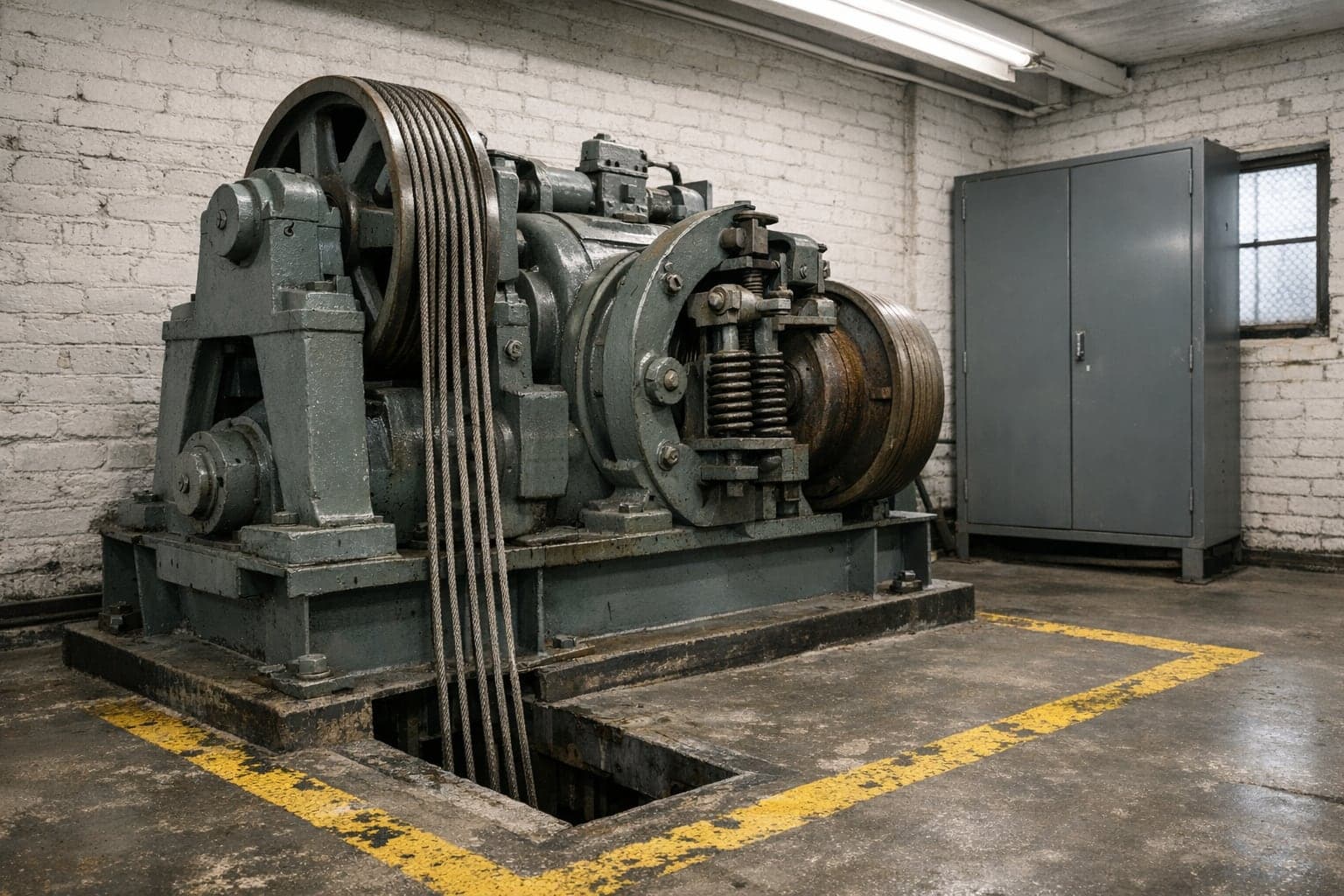
The brake on a traction machine holds the car at the floor when the motor is off. Older machines use a single solenoid plunger to release that brake, which means one stuck or failed component can let a loaded car drift away from the landing with the doors open. A dual-plunger brake gives the system a second, independent means of applying the brake, and unintended car movement protection, most often a rope gripper that clamps the hoisting ropes, stops the car if it moves when it should not.
Boards usually do not know which brake their machine has. Three ways to find out this week:
- Ask your maintenance contractor in writing. They service the machine monthly and will know the brake type on sight.
- Ask the agency that performs your annual Category 1 test. Under the DOB elevator compliance rules, that agency cannot be affiliated with your maintenance company, so it is an independent answer.
- Check the machine room. Machines modernized in the last decade generally already have a dual-plunger brake or a gripper, and the manufacturer's documentation should be on site.
If the elevator was fully modernized recently, you likely have nothing to do except confirm it on paper. If the machine is original or was last touched in the 1990s, assume you are affected until proven otherwise.
3. The Two Fixes DOB Accepts, Compared
The notice does not prefer one option over the other. The choice comes down to the age of the machine, what the controller can support, and whether the board is already planning a modernization.
| Option | What it is | Where it fits | Watch for |
|---|---|---|---|
| Dual-plunger brake conversion | Replaces or alters the brake assembly on the existing traction machine | Machines in good condition with a manufacturer-supported conversion kit | Parts availability for older machines; the machine itself stays the same age |
| Unintended car movement protection | An added safety device, typically a rope gripper, that meets ASME A17.1-2013 Section 2.19.2 | Machines where a brake conversion is impractical, or boards that want a self-contained add-on | Needs controller integration and space in the machine room |
| Full modernization | Replaces the machine, controller, and brake together | Elevators already near the end of their service life | The largest scope; only an option if the work can finish and pass its test by January 1 |
Whichever path you pick, the design must be documented. Per the notice, design drawings and the approval letters from the manufacturer or a registered design professional do not get submitted to DOB, but they must be kept in the machine room and produced on request. Put a copy in the board's files as well, because machine rooms lose paperwork.
4. How the Filing Works in DOB NOW: Build
The filing path is specific, and it is where boards lose weeks. According to the July 29 notice:
- The application is filed in DOB NOW: Build using the PPN process.
- It must be filed by an Elevator Agency Director or Co-Director approved by DOB, not by an architect or engineer.
- The elevator agency director must email DOB at least 48 hours before the inspection and test.
- The agency performing the test, a second agency witnessing it, and the owner all sign off on the application in DOB NOW: Build.
- DOB will not issue a Certificate of Compliance for this work. The signed-off application is the record.
That owner sign-off is the board's step, and it cannot be delegated to the contractor. Someone on the board or at the managing agent needs a working NYC.ID login tied to the building, which DOB requires for every DOB NOW: Build user. If your building has never set one up, do it now rather than in the last week of December, and read our guide to how elevator acceptance tests are witnessed under DOB's third-party pilot for how the performing and witnessing agencies divide the work.
In the buildings we manage, the brake retrofit itself is rarely the hard part. The hard part is that four parties have to act in sequence: the elevator company files, DOB gets 48 hours' notice, two agencies witness the test, and then the owner signs in DOB NOW. Any one of those steps slipping two weeks in December turns a 60-day runway into a missed deadline.
5. What Happens After January 1
The notice does not list a dollar penalty, so look at the last time DOB enforced a retroactive elevator rule. For the door lock monitoring deadline of January 1, 2020, DOB's industry notice said the Department would issue OATH summonses to owners of non-compliant devices after the deadline, with follow-up inspections and additional violations if the device stayed non-compliant. It also required inspection agencies to report a missing or non-working system as a defect in DOB NOW: Safety during the annual Category 1 test.
Expect the same mechanics here. The enforcement triggers DOB named in 2020 were Category 1 tests, periodic inspections, complaint inspections, and acceptance tests, and every elevator in the city goes through at least two of those in 2027. A non-compliant brake will surface in the first Category 1 test of the new year, and from there the standard elevator compliance schedule takes over:
| Item | Residential elevator rule | Source |
|---|---|---|
| Category 1 test window | January 1 to December 31, filed within 21 days | DOB |
| Defect correction | Within 90 days of the test; filed within 14 days of correction | DOB |
| Failure to correct | Violation at 104 days; $1,000 per device | DOB |
| Late Category 1 filing | $50 per month per device, capped at $600 per year | DOB |
| Failure to file Category 1 | $1,000 per device | DOB |
| DOB violation issued by an inspector | Correct within 10 calendar days | DOB |
Those are the routine numbers. The larger exposures are the ones that do not show up on a fee table: a cease-use violation on the building's only elevator, a stalled refinance or sale while a violation sits open, and the liability of running a car that DOB has said, in writing, must be altered.
6. The Board's 60-Day Plan
Working back from January 1, here is the calendar we are running for the buildings that have not yet started.
| By | Action | Owner |
|---|---|---|
| November 6 | Written confirmation of brake type for every traction car; identify the Elevator Agency Director who will file | Managing agent and maintenance contractor |
| November 13 | Proposals in hand for the conversion or gripper; board votes by email or at a special meeting | Board |
| November 20 | Contract signed; parts ordered; permit application filed in DOB NOW: Build | Elevator agency |
| December 4 | Owner's NYC.ID access to DOB NOW: Build confirmed; witnessing agency booked | Managing agent |
| December 18 | Installation complete; 48-hour test notice sent to DOB | Elevator agency |
| December 23 | Witnessed test passed; performing agency, witnessing agency, and owner sign off | All three |
| January 1, 2027 | Deadline | DOB |
This schedule assumes two things. First, that a conversion kit or gripper is available for your machine within the month, which is a question to put to the contractor before the board votes, since parts for older machines can take longer than the installation.
Second, that the board can vote within a week. If your bylaws require notice for a special meeting, send it the day the proposals arrive.
Boards whose elevators are mid-project should pull the DOB NOW job number today and confirm which of the sign-offs are still open. A permit on file is not compliance; the notice is explicit that the work is complete only when the test is passed and signed.
7. Paying for It: Reserves, Assessments, and the 2027 Budget
The brake deadline lands in budget season, which is the one piece of good timing it offers. Boards are finalizing 2027 operating budgets right now, and the same packet should carry a reserve draw or a special assessment line for this work, approved on the record.
The pressure on that budget is real. The Rent Guidelines Board's 2026 Price Index of Operating Costs measured building operating costs up 5.3% year over year with insurance up 10.5%, figures we covered in our breakdown of the RGB Income and Expense Study. A one-time safety retrofit is exactly what a reserve fund exists for, and our guide to reserve fund planning for NYC co-op boards explains the 10% reserve test lenders apply and when an assessment is the cleaner choice.
If the building is also filing for the co-op and condo tax abatement by February 15, 2027, the two items belong on the same November agenda: one brings money in, the other sends it out, and shareholders deserve to see both at once. And if nobody on the board can say today which brake the machine has, that is a sign the building's managing agent is not tracking the DOB calendar the way the role requires. Our overview of what a condo association management company does lists the filings an agent should carry without being asked, and this is one of them.
The NYC elevator brake deadline has been on the books for years, and DOB called its July notice a final reminder for a reason. For a board, the risk is not the retrofit, it is the sequence of permit, test, and sign-off that has to finish inside 60 days. Confirm the brake type this week, vote next week, and let the elevator company run the rest while the board keeps its eye on the DOB NOW sign-off.
About the Author
Brandon Babel is the Founder and CEO of Ora Property Management, serving condo and co-op boards and rental owners across Manhattan and Brooklyn. He founded Ora to bring transparent, communication-first management to small and mid-sized buildings, drawing on years across the financial, operational, and ownership sides of New York real estate.
Learn more about Ora · Connect on LinkedIn · Contact Brandon
Continue Reading


Have a Question About Your Property?
We’re always happy to talk — no commitment required.